
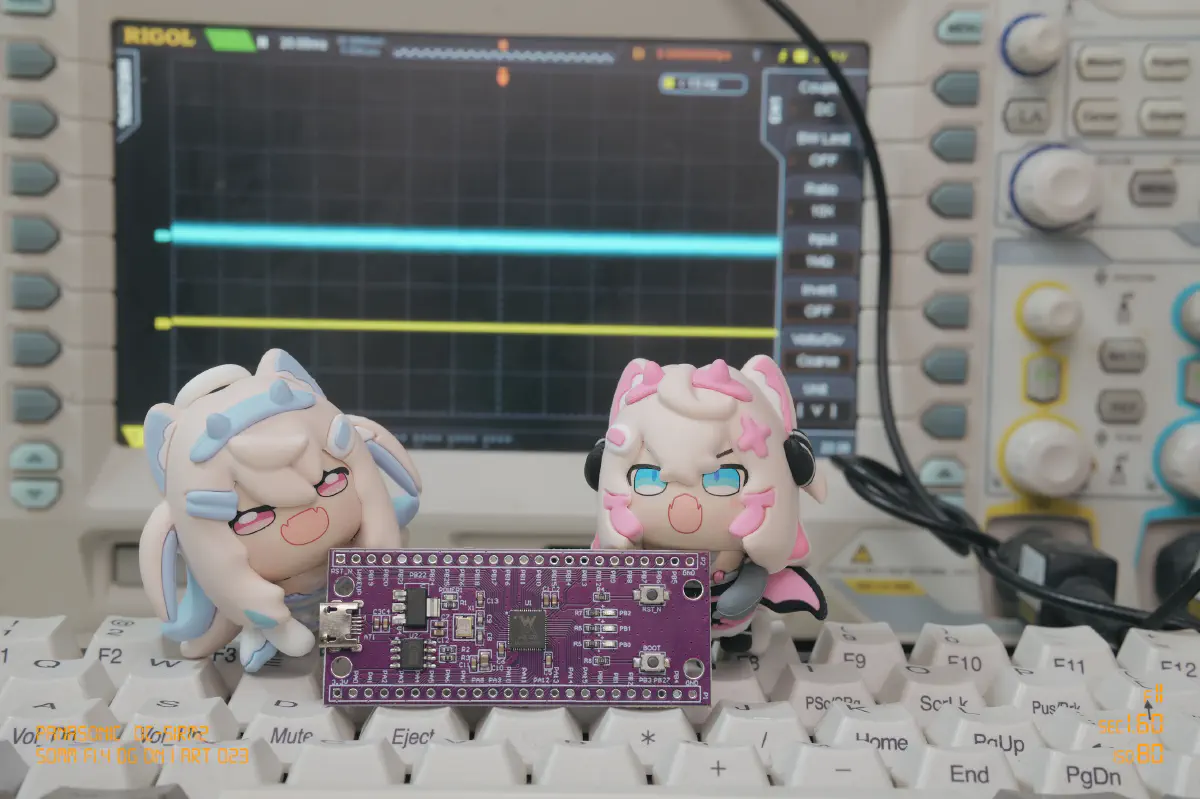
This article covers only the public C-SKY architecture, a generic QEMU environment, and validation on the commercially available HLK-W806-KIT.
csky-rust-buildroot: https://github.com/pmnxis/csky-rust-buildroot
Espressif’s ESP32 series uses Xtensa LX and RISC-V, while GigaDevice’s GD32 series uses Arm Cortex-M and RISC-V. Less well known are the C-SKY-based MCUs found in some wireless and appliance products for the Chinese domestic market.

Could a simple product like this contain an 8051 or C-SKY MCU?
Rust already has the Tier 3 csky-unknown-linux-gnuabiv2 target, and LLVM has a
C-SKY code generator. That path, however, builds Linux programs. An MCU
bare-metal environment including startup code, vector tables, interrupts,
linker scripts, and core was not available.
This article describes building a csky-unknown-none-elfabiv2 environment,
producing firmware with Rust and LLVM/LLD without a GCC linker, and running the
Embassy executor, timers, and embassy_sync::Channel on QEMU’s CK801, CK802,
CK803, CK804, and CK805 profiles and on a real WinnerMicro W806.
Results first#
As of September 2026, I have verified the following:
- Patched Rust/LLVM produces bare-metal Rust binaries for CK801, CK802, CK803, CK804, and CK805.
- Patched LLD links little-endian ELF32 for C-SKY, without using a GCC
toolchain
ldfor the final link. - Generic C-SKY QEMU runs workloads covering reset, memory initialization, IRQs, compiler builtins, and Embassy wake/timer/queue behavior.
- CK804 passes queue-capacity-eight saturation, repeated cancellation, simultaneous deadlines, IRQ priority, and 64-bit timebase wrap checks.
- Standard Embassy Channel ping/pong tasks run in QEMU and on the HLK-W806-KIT.
- A 1 ms TIM0 IRQ drives the Embassy time driver on W806, and the real board
wakes from
wait32instead of busy-spinning.
This is not yet a finished target upstreamed to rustc. The official rustup
rust-lld does not contain this C-SKY bare-metal work either. These results use
a project-local compiler and patch series.
Why Rust?#
Simply because I like Rust more than C.
I previously documented my experience in the My First Mass Production With Rust Embedded series. More importantly, I developed a Rust embedded product entirely on my own and took it all the way through mass production and release to the marketplace.
C-SKY and CK80x#
C-SKY is a 32-bit RISC ISA. This work focuses on the ABIv2 CK80x MCU family. CK801 and CK802 are small-MCU profiles; the available instructions and CPU configuration change through CK803, CK804, and CK805. These numbers should not be mapped one-to-one to Armv6-M or Armv7-M because the ISA, ABI, exception entry, and interrupt-controller models differ.
For instruction-set, register, and exception-model details, I referred to the
C-SKY Architecture User Guide.
The following differences matter especially to an MCU runtime:
- Exception entry and return must follow the PSR/EPSR/EPC and CPU/compiler
interrupt-frame rules.
ipushandipopare ISA instructions used in this context handling. The public W806 SDK’svectors.Ssaves general registers and EPSR/EPC on trap entry, while itstspend_handlersaves and restores task context including EPSR/EPC. - The architecture’s base exception vectors and a SoC’s total vector count are separate concerns. A real MCU may expose 48 or 64 entries.
- The VBR (Vector Base Register) location and whether ROM vectors are copied into RAM are chip/runtime policies.
- CPU interrupt enable and the SoC interrupt controller’s enable, pending, priority, and wake-enable states are separate.
Public boards include the W800 Arduino, W803 Pico, HLK-W800, and HLK-W806. Their pinouts and flash layouts differ, but they are not each a separate Rust ISA target. I chose the readily available W806 on the HLK-W806-KIT—an XT804/CK804EF-family device—for hardware validation.
Why more work was needed despite the LLVM backend#
“LLVM has a C-SKY backend” does not mean “Rust bare-metal firmware can be completed.” The latter requires every layer in this path:
flowchart TB
    APP["1. Application / runtime

Cortex-M: Embassy + cortex-m + cortex-m-rt
C-SKY: C-SKY-enabled Embassy + csky + csky-rt"]
    TARGET["2. Target / base libraries

Cortex-M: built-in rustc target + distributed core
C-SKY: custom target JSON + build-std core / compiler_builtins"]
    TOOLS["3. Codegen / linking

Cortex-M: distributed rustc / LLVM Arm + rust-lld
C-SKY: project-local rustc / patched LLVM + patched ld.lld"]

    APP --> TARGET --> TOOLS
Application and runtime
On Cortex-M, Embassy runs oncortex-mandcortex-m-rt. For C-SKY, the corresponding roles are filled by C-SKY-enabled Embassy andcsky/csky-rt. In particular, the runtime must implement reset entry, memory initialization, the vector table, and interrupt entry/return for the architecture.Target and base libraries
Common Cortex-M target information is built into rustc, and rustup shipscorefor those targets. Because a C-SKY bare-metal target is not yet an official distribution, a custom target JSON supplies CPU and ABI properties, andbuild-stdbuildscoreandcompiler_builtinsfrom source.References:
Code generation and linking
rustc does not compile Rust through Clang; it uses LLVM libraries as its code-generation backend. Cortex-M can use the distributed rustc LLVM Arm backend andrust-lld. The current C-SKY setup creates objects with the patched LLVM C-SKY backend in a project-local rustc, then combines them into a bare-metal ELF with patchedld.lldandlink.x. Clang is the C/C++ front end in the same LLVM ecosystem and does not participate in this Rust path.
This research uses two LLVM trees:
- LLVM bundled with the Rust source handles C-SKY codegen for rustc.
- A standalone LLVM tree builds
ld.lld,llvm-readelf,llvm-objdump, and related tools.
The custom target JSON passes CPU, ISA feature, endianness, pointer-width, and
atomic capabilities to rustc. Since rustup has no core for the custom target,
it is built with -Z build-std=core,compiler_builtins. no_std means not using
std; it does not mean that core is unnecessary.
LLVM/LLD additions#
The applied order and patch files are in
patches/llvm.
- assembler
.ltorg/.poolliteral-pool directives - a little-endian ELF32 C-SKY LLD backend and initial relocations
- range and alignment checks for PC-relative IMM16 relocations
- naturally aligned 8/16/32-bit atomic load/store codegen
The last item directly affects Embassy. A lack of compare-and-swap on CK80x is
not the same as being unable to perform ordinary atomic loads and stores. The
target declares max-atomic-width = 32 and atomic-cas = false, while LLVM
generates the supported atomic loads/stores. This made it possible to use the
standard embassy_sync::Channel without adding a C-SKY-only queue to Embassy.
LLD dynamic linking, TLS/GOT/PLT, ELF attribute merging, compatible-CPU
e_flags merging, long-branch thunks, and big-endian regressions are not yet
complete. Static bare-metal MCU ELF was validated first.
csky and csky-rt#
Like cortex-m and
cortex-m-rt in the Arm ecosystem,
the implementation is split into two layers.
The csky crate provides CPU-level functionality:
- architectural-register APIs for PSR, VBR, SP, EPSR, EPC, CPUID, and others
- interrupt masking and a critical-section backend
- compiler and hardware barriers
- low-level instructions such as
nopandwait
csky-rt handles the path before the program
reaches main and interrupt entry:
- reset handler, stack,
.datacopying, and.bssinitialization - the
#[csky_rt::entry]Rust entry macro - 32/48/64-entry vector layouts and a default handler
- VBR policy for moving flash vectors into RAM
- an assembly wrapper that transfers control to a Rust IRQ handler
W806 clock, GPIO, UART, TIM, and VIC registers belong in a SoC HAL/BSP. The generic runtime lets a user choose vector size and VBR policy but does not embed a particular product’s memory map.
IRQ frames depend on CPU features#
C-SKY ipush alone does not preserve every register required by a Rust call.
The wrapper additionally saves r15 and, on CK804E/EF with high registers,
r18–r31. Conversely, that same frame must not be used unconditionally on CPUs
that do not have those registers. Nested IRQ frames therefore need validation
for each CPU profile.
※ The W806 is a CK804EF, but the current target disables LLVM’s FPU instruction feature.
Embassy executor and idle#
Embassy is a Rust embedded ecosystem that brings async/await to MCUs. It
fits the goal of dividing timer and protocol state machines into tasks with
explicit await boundaries.
The main change is confined to the architecture-specific part of
embassy-executor. embassy-time, embassy-time-driver,
embassy-time-queue-utils, and embassy-sync remain unchanged where possible.
The Channel issue was solved by fixing LLVM atomic support instead of placing a
temporary C-SKY implementation in Embassy.
Idle behavior turned out to be a deeper issue. After establishing correctness
with a spin loop, I applied csky::asm::wait(). Executing wait32 inside a
critical section with interrupts masked prevents wakeup, while sleeping just
after enabling interrupts creates a check-then-sleep boundary race.
The current implementation uses this sequence:
- Mask interrupts and recheck the executor work flag.
- If there is no work, wait with adjacent
psrset ie→wait32. - W806 uses a recurring 1 ms IRQ, so even a short boundary race advances on the next tick.
flowchart LR
    CHECK["1. Mask interrupts
recheck work flag"] --> WORK{"Work pending?"}
    WORK -- "yes" --> RUN["Run executor"]
    WORK -- "no" --> WAIT["2. psrset ie → wait32
enable interrupts, then wait"]
    WAIT --> IRQ["3. Current or next 1 ms IRQ
wake even after boundary race"]
    IRQ --> RUN
Why QEMU came first#
The QEMU patch order and the purpose of each patch are documented in
patches/qemu.
With hardware alone it is difficult to separate interrupt-frame, compiler codegen, and peripheral-configuration faults. QEMU makes it possible to build small ELFs and repeatedly inspect register, exception, and memory state.
After reviewing the early C-SKY QEMU 6.x code, I moved to the XUANTIE QEMU 9 branch and improved interrupt-controller pending masks, priorities, IRQ lifecycle, and EPSR preservation.
The public buildroot QEMU is not a board model that duplicates a commercial MCU. It validates the compiler/runtime/executor with a generic CPU, interrupt controller, timer, UART, and semihosting. It contains no product peripheral, ROM, or application protocol. Passing QEMU therefore does not automatically prove a particular device’s clock, IRQ, or peripheral compatibility.
What was validated#
- reset, stack,
.data,.bss, and vector base - critical sections, repeated IRQs, and callee-saved register canaries
- 256-iteration IRQ stress and
compiler_builtins - Embassy task wake, timer ordering, and cancel/re-arm
- completion of a ninth task after saturating a queue of capacity eight
- same-deadline alarms and differing interrupt priorities
- deadlines immediately before and after counter wrap and 64-bit Embassy
Instant
The workload matrix ran on five profiles: CK801, CK802, CK803, CK804, and CK805.
LLVM code and QEMU results still disagree on 64-bit division/remainder that
uses CK802 E2 instructions. A temporary -e2,+e1 workaround is not considered
completed CK802 E2 support.
※ E1 and E2 are names used by the C-SKY ABIv2 toolchain for extension groups added above the base ISA. E1 is the first group associated with CK801; E2 is the next group associated with CK802. In LLVM, E2 includes E1. -e2,+e1 keeps the CK802 CPU selection but disables E2-specific instruction generation, leaving instructions through E1 enabled. It neither changes the CPU to CK801 nor changes ELF ABI v2 to v1.
Bringing up the HLK-W806-KIT#
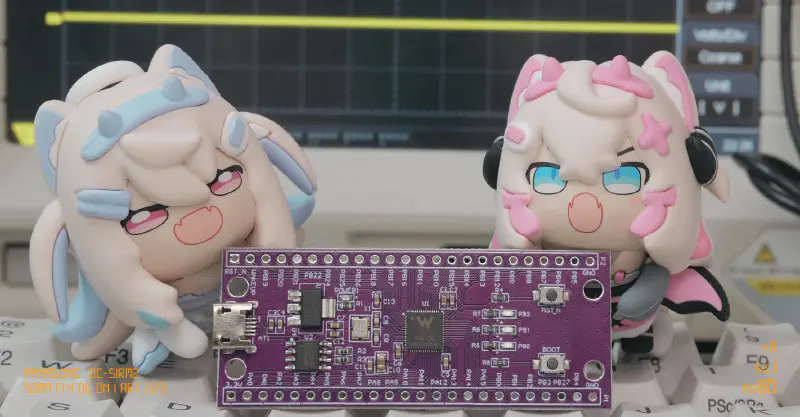
The WinnerMicro W806-based HLK-W806-KIT used for hardware validation.
The relevant W806 configuration is:
CPU              XT804 / CK804EF family
application      0x0801_0400
vector RAM/VBR   0x2000_0000, 64 entries
UART0            115200 baud
Embassy tick     APB TIM0, IRQ 30, 1 ms recurring
idle             C-SKY wait32
When the timer initially failed, I checked CORET, VIC, priority, and PSR one by
one. I first proved that the TIM0 IRQ and ping/pong worked while busy-spinning;
after applying wait32, execution again stopped at the first wait.
The cause was that W806 VIC interrupt enable and wake enable are separate
registers. Enabling IRQ30 only in ISER delivers the IRQ while the CPU is
running, but cannot wake a CPU in wait32. After setting the IRQ30 bit
0x4000_0000 in VIC IWER0 (0xe000_e140), every tick woke the CPU and polled
the executor.
The hardware produced this output:
HLK-W806 Embassy multi-task started
ping: received=0, sent=1, elapsed_ms=250
pong: received=1, sent=2, elapsed_ms=1000
ping: received=2, sent=3, elapsed_ms=250
pong: received=3, sent=4, elapsed_ms=1000
The example exchanges DummyCounter { value: i32, time: Instant } through a
standard Embassy Channel. Ping awaits 250 ms and pong awaits 1,000 ms. This
output is therefore evidence that all of the following layers worked together:
TIM0 hardware IRQ
  → csky-rt interrupt entry/frame
  → Embassy time driver and timer queue
  → C-SKY executor
  → embassy_sync::Channel
  → ping/pong futures
Reproducible csky-rust-buildroot#
I packaged this work as csky-rust-buildroot. It is not Linux Buildroot; it is
a source buildroot and example workspace that uses Cargo xtask to reproduce
the compiler, emulator, and examples.
# Install dependencies for the host distribution.
cargo xtask deps

# Fetch the pinned Rust/LLVM, standalone LLVM, QEMU, and Embassy, then patch them.
cargo xtask fetch

# Build the local rustc, LLVM/LLD tools, and QEMU.
cargo xtask tools

# Run the basic timer example in QEMU.
cargo xtask run

# Run the standard Embassy Channel multi-task example.
EXAMPLE=embassy-multi-task RUN_SECONDS=15 cargo xtask run

# Decode QEMU transport defmt frames live.
DEFMT_LOG=trace RUN_SECONDS=15 cargo xtask run-defmt

# Flash the HLK-W806-KIT and follow its UART log.
./scripts/run-w806.sh multi-task ttyUSB0 --manual-reset
This is longer than cargo run --example because it does not merely build one
package. The project-local rustc, custom target, build-std, patched LLD, image
generation, and QEMU or flashing must be selected as one consistent set. Host
Cargo is the orchestrator, while .local/rust/bin/rustc performs codegen and
.local/bin/ld.lld performs the link.
This work was developed only on Linux hosts. Windows and macOS were not tested separately.
Remaining work#
- Determine how CK801/CK802 CPU-profile selections and E1/E2 feature overrides affect the actual supported instruction set (insufficient information today)
- an atomic idle/wakeup rule applicable to one-shot IRQs
- IRQ context save/restore for CK804EF with the FPU enabled
- more LLD relocations, attributes, thunks, and endian coverage
- an upstream and rustup distribution path for rustc/LLVM/LLD
- clock, flash, IRQ, and peripheral validation on public C-SKY MCUs beyond W806
Success on QEMU and W806 must not be generalized to every C-SKY MCU. CPU features, vector count, interrupt controller, wake registers, ROM contracts, and memory maps can vary by SoC.
Closing#
The starting assumption was, “LLVM has a C-SKY backend, so perhaps one target JSON is enough.” In practice, codegen, the linker, runtime, vector/IRQ ABI, atomics, executor, emulator, and SoC wake mechanisms all had to be understood, and substantial work was required to connect them into one continuous path.
It is now possible to create C-SKY bare-metal ELF with Rust and LLVM/LLD without
a GCC linker, regression-test several CPU profiles in QEMU, and run a
wait32-based Embassy executor, hardware timer, and standard Channel on a real
W806.
This foundation can test and analyze C-SKY binaries. Dedicated scratch registers in the virtual QEMU environment can also inject external state and inputs, enabling firmware behavior and features to be tested under emulation. I expect this to be useful for CI/CD regression tests and C-SKY firmware research. Validation on more commercially available C-SKY MCUs is the next goal.
Related material#
- C-SKY Rust buildroot and examples: https://github.com/pmnxis/csky-rust-buildroot
- LLVM/LLD patch series: https://github.com/pmnxis/csky-rust-buildroot/tree/main/patches/llvm
- QEMU patch series: https://github.com/pmnxis/csky-rust-buildroot/tree/main/patches/qemu
- Embassy fork integration notes: https://github.com/pmnxis/csky-rust-buildroot/tree/main/patches/embassy
cskyarchitecture crate: sourcecsky-rtruntime crate: source- Experimental C-SKY Embassy branch: https://github.com/pmnxis/embassy/tree/feature/csky-experimental
- C-SKY architecture documentation: https://github.com/c-sky/csky-doc
- XUANTIE QEMU: https://github.com/XUANTIE-RV/qemu
- Embassy: https://github.com/embassy-rs/embassy
- WinnerMicro W800 documentation: https://doc.winnermicro.net/w800/en/latest/